Chinese scholar positive on Vietnam’s two-tier local government model
VOV.VN - Vietnam’s two-tier local government model is a bold administrative reform effort that demonstrates the Vietnamese Government’s determination to streamline and simplify public administration.
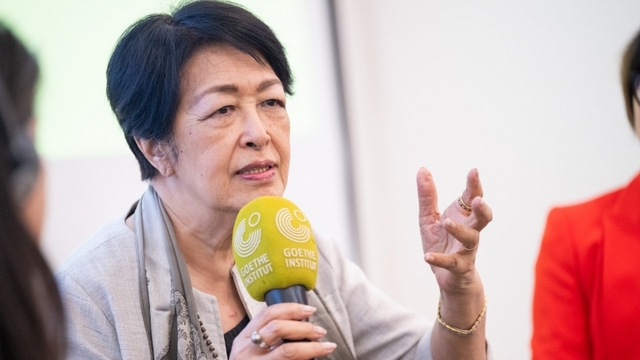
Senior Professor Tao Yitao, former Deputy Secretary of the Communist Party Committee of Shenzhen University and Director of the China Center for Special Economic Zone Research (Photo: VNA)
The assessment was made by Senior Professor Tao Yitao, former Deputy Secretary of the Communist Party Committee of Shenzhen University and Director of the China Center for Special Economic Zone Research in a recent media interview in China
According to Tao, one of the model’s key advantages lies in improving the efficiency of flat governance. First, eliminating intermediary levels and allowing provincial authorities to directly manage commune-level administrations could, in theory, significantly reduce administrative costs and improve policy transmission.
Second, the direct allocation of resources and decentralisation of public services would enable resources to reach the grassroots level more directly, avoiding “intermediate intervention”, improving the responsiveness of public services and contributing to better living standards.
From the perspective of institutional economics, Tao said reducing administrative layers is not simply a matter of streamlining institutions but also involves reallocating management responsibilities and transaction costs.
Vietnam’s decision to abolish the district level and restructure its administrative system into a province-commune model shows an ambition for political reform aimed at addressing information loss and concentration of power within the “principal-agent” chain through vertical flattening, allowing the will of the state to reach the grassroots level more directly.
Tao stressed that one year is not enough to judge the success or failure of a system. However, she said the model’s innovation lies in its willingness to move beyond dependence on the “thousand-year-old district-level system”, while its deeper significance lies in demonstrating that all administrative reforms ultimately come down to political reform.
If power is not devolved to the people and accountability is not strengthened under the rule of law, simply adding or removing levels within an administrative hierarchy cannot achieve the original objectives or positive outcomes of reform.
To resolve future challenges, the Shenzhen University professor suggested that Vietnam focus on three areas in subsequent reforms to ensure steady and sustainable progress.
First, she said Vietnam need to scientifically determine the alignment of authority, financial resources and personnel to establish a unified system of powers, responsibilities and benefits.
The core of administrative reform, she noted, is ensuring consistency among these three elements. This means that when provincial governments delegate administrative authority to commune-level administrations, they should also transfer corresponding financial resources.
For example, a standard transfer payment system could be established to ensure that commune-level governments have sufficient capacity to perform public service functions. Local governments should also be granted certain powers in personnel appointment and evaluation to strengthen their capacity for self-governance.
Second, Tao recommended making greater use of digital technology to compensate for the expansion of management responsibilities and to build a digital government capable of overcoming organisational limitations. Vietnam, she said, can take advantage of its latecomer position to accelerate the development of e-government and digital governance platforms.
Through big data, cloud computing and other technologies, provincial authorities can achieve real-time supervision and more effective management of commune-level affairs, helping address the challenge of administrative overload without creating additional administrative tiers.
Third, she underscored the need to strengthen the professional capacity of grassroots civil servants to improve governance effectiveness. As administrative levels are streamlined, management tasks at the commune level become more complex.
Greater investment in training grassroots officials and attracting professional management talent, particularly in areas such as public finance, urban planning and public services, will help enhance planning, implementation and emergency response capabilities at the local level.
Tao expressed confidence that as long as Vietnam adheres to a people-centred development philosophy, administrative reform will deliver positive results.
She said the country’s new image creates opportunities for the world to learn more about Vietnam and for Vietnam to reach out to the world, further highlighting the appeal of Vietnam’s institutions.
VOV.VN - Vietnam will carry out a nationwide assessment of the effectiveness of its two-tier local government model after one year of implementation, as the country continues pushing forward administrative reform and state apparatus restructuring.
The Party Central Committee's Politburo and Secretariat have urged efforts to further refine and enhance the efficiency of the political system and the two-tier local government model, according to Conclusion No. 202-KL/TW signed by Politburo member and Permanent Member of the Secretariat Tran Cam Tu on October 31.
VOV.VN - Vietnam will carry out a nationwide assessment of the effectiveness of its two-tier local government model after one year of implementation, as the country continues pushing forward administrative reform and state apparatus restructuring.
The Party Central Committee's Politburo and Secretariat have urged efforts to further refine and enhance the efficiency of the political system and the two-tier local government model, according to Conclusion No. 202-KL/TW signed by Politburo member and Permanent Member of the Secretariat Tran Cam Tu on October 31.










.JPG&w=640&q=100)








Bình luận
Bình luận của bạn sẽ được xét duyệt trước khi đăng