
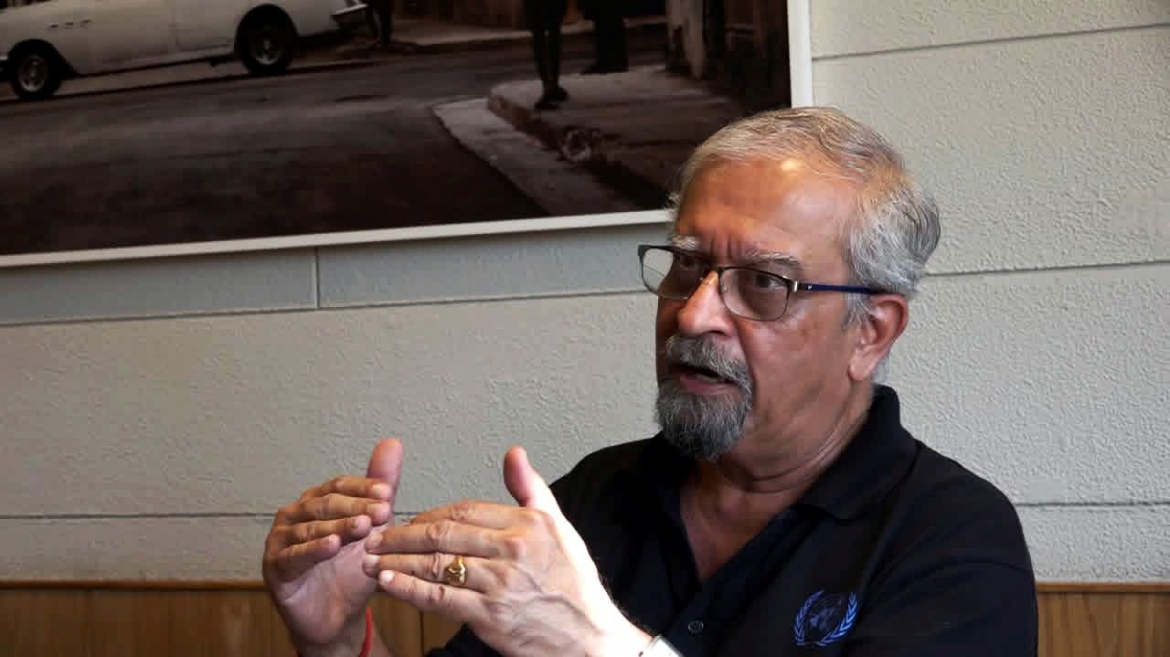

VOV.VN - Amid growing geopolitical uncertainty and increasingly complex global challenges, Professor Kamal Malhotra, India’s global political and economic analyst, believes Vietnam is emerging as an increasingly important contributor to regional and global affairs.
In an exclusive interview granted to VOV.VN, Professor Malhotra who is also a past Senior Fellow at Boston University and a former United Nations Resident Coordinator in Vietnam, discussed the future of the international order, the role of the United Nations and ASEAN, and how Vietnam can help advance multilateral cooperation and international governance.
Following is the full text of the interview.
VOV: Good evening, Professor Malhotra. As you might know, the world is currently experiencing an unprecedented historical moment. The international order that has remained relatively stable for decades is being challenged and reshaped by major powers. The use of force is increasingly taking precedence over diplomacy in resolving disputes. How do you view the current trends in international politics and security?
Prof. Malhotra: Thank you for inviting me to your show. It is certainly true that the global liberal international order, which was created out of the ashes of the Second World War and centered around the United Nations, is facing its most challenging and troubling moment in the last 80 years.
While support for the UN Charter and international law continues to be expressed, both have come under increasing strain as some major powers, along with countries involved in regional conflicts, have not consistently acted in accordance with these principles.
This provides very little incentive for other UN member states to fully uphold the UN Charter and the international rule of law. Therefore, we are in unprecedented waters in terms of the international order since the end of the Second World War.
VOV: As you said, the current historical context has underscored the urgency for nations to exercise self-restraint when dealing with conflicts and disputes involving national interests. How do you assess the importance of such restraint today?
Prof. Malhotra: Recent conflicts have shown that even some permanent members of the UN Security Council have not always exercised the restraint expected of them. This has raised serious concerns about respect for the UN Charter and international law.
Since 2022, some other countries have continued to provide military support to Israel during the conflict in Gaza. Therefore, they too have not shown the necessary responsibility and restraint.
Such restraint, in favor of diplomacy and dialogue at the United Nations, appropriate regional multilateral bodies, and bilateral channels, is crucial to demonstrate that the international rule of law and the UN Charter must be respected and upheld.
We are therefore in an unprecedented situation in which some of the most important members of the UN Security Council have, in my view, failed to uphold the principles of the UN Charter and international law.
What we need is for the UN Charter and the international rule of law to be respected—not just in words, not selectively, but consistently through actions and deeds. That is not happening. In fact, it is happening less and less, and some of the most influential countries have not consistently upheld these principles.
VOV: At the same time, the world needs international cooperation more than ever to address global challenges such as climate change, pandemics, energy security, and the green transition. How is the current fragmentation of the global order affecting international cooperation on these pressing issues?
Prof. Malhotra: International cooperation is needed more than ever to address the global public policy challenges you have mentioned. However, current unilateral actions by some key UN member states are undermining such cooperation and, consequently, the possibility of addressing these interconnected global challenges.
None of these challenges can be addressed unilaterally, bilaterally, or even regionally. They all require concerted, sustained, and genuine international cooperation through global multilateral organizations and platforms such as the United Nations.
VOV: Questions are increasingly being raised about the role of the United Nations as the foremost institution responsible for maintaining international peace, security, and development. In your view, is the UN fulfilling its responsibilities effectively today?
Prof. Malhotra: Some of the questions being raised are valid, though not all of them. It is true that the United Nations has faced unprecedented challenges. as never before in the last eight years.
However, there is no alternative to the United Nations. If it did not exist, the world would have to reinvent it. It is crystal clear to me that any new organization created in today’s toxic geopolitical environment to replace the United Nations would be far weaker and less effective than the current, albeit undermined, UN.
This is especially true if we want to address the urgent global challenges you mentioned earlier. Therefore, instead of criticizing the United Nations, everyone should work to transform it into the kind of effective organization it was during much of the Cold War period and through the adoption of the Sustainable Development Goals—the most important set of development goals ever agreed upon in human history.
I have written extensively since 2015 about how the United Nations can be reformed and transformed, and I believe this can be done. Many countries can help show the way forward. I believe the One UN approach led by Vietnam for many years is part of that path, both globally and regionally, as well as within countries themselves.
Vietnam therefore has a particularly important role to play in demonstrating how the United Nations can move forward.
VOV: Many of the challenges facing the contemporary world were highlighted by Vietnam’s top leader, General Secretary and State President To Lam, in his keynote address at the Shangri-La Dialogue 2026 in Singapore. He identified three major global crises: a crisis of international order, a crisis of the development model, and a crisis of strategic trust, all contributing to global instability while urgent challenges remain unresolved. What is the significance of these remarks?
Prof. Malhotra: General Secretary and State President To Lam’s keynote address at the Shangri-La Dialogue was impressive and statesmanlike.
He correctly identified three major global crises. There are others, but these are certainly among the most important. He also outlined a way forward that largely endorsed multilateralism, the United Nations, international law, and the need to implement all agreed global conventions, even when they are not legally binding.
His speech reaffirmed the relevance of the three key pillars of the United Nations: security, human rights, and sustainable development. He also correctly emphasized that there can be no security without sustainable development.
Furthermore, his speech recognised that the Asia-Pacific region is at the center of global affairs in the 21st century and that both ASEAN and Vietnam must not merely adapt to the evolving global order but actively help shape both the global order and the region’s future.
VOV: Vietnam’s leaders have also put forward several notable proposals aimed at overcoming these challenges, narrowing differences, rebuilding trust, and strengthening cooperation among nations. In your opinion, how feasible are these ideas?
Prof. Malhotra: Vietnam’s proposals are entirely possible and achievable if there is sufficient political will and mutual trust. As General Secretary and State President To Lam emphasised, cooperation must be built upon trust.
However, this also requires a united ASEAN that is willing to play a more proactive role in defining the future of the Asia-Pacific region and influencing the broader global future. ASEAN cannot remain passive. It cannot simply adapt to a changing global order; it must actively help shape that order.
I think this is extremely important. In that regard, both General Secretary and State President To Lam and your Prime Minister, in his recent speech at the third ASEAN Future Forum, conveyed appropriate and constructive messages.
VOV: In recent years, observers have noted that Vietnam is moving beyond active participation in international affairs toward proactively contributing ideas, initiatives, and responsibilities to promote peace, security, stability, and development at both regional and global levels. This shift has become evident in the discourse of its leaders. How do you see Vietnam carrying out this transformation in its international role?
Prof. Malhotra: Vietnam is certainly beginning to play a greater role, both regionally and internationally, with increasing confidence.
The two Vietnamese leaders’ speeches at the Shangri-La Dialogue and the ASEAN Future Forum are two concrete examples of Vietnam’s advocacy for a larger role for both Vietnam and ASEAN at the regional and global levels.
Vietnam’s advocacy as a leader of the One UN approach at the country level, and its call for this approach to be scaled up globally and regionally, are also significant. This advocacy is being actively promoted by Vietnam’s Permanent Representative to the United Nations in New York, Ambassador Do Hung Viet.
All of these are important new roles that Vietnam is undertaking confidently and with the backing of practical experience.
Vietnam’s expanding role is both timely and appropriate, given its increasing importance in regional and global supply chains, its growing contribution to UN peacekeeping operations, its successful bamboo diplomacy between the two major global powers—China and the United States—over several decades, and its Five Nos policy of neutrality.
These are all concrete examples of why Vietnam can credibly play a greater role. I am pleased to see that it is beginning to do so with greater confidence at both the regional and global levels.
All of this gives Vietnam credibility with other countries and provides it with a degree of strategic autonomy because of its bamboo diplomacy and Five Nos policy. These two elements are particularly important to emphasise.
Vietnam should use these assets proactively to help shape the future of both ASEAN and the United Nations.
VOV: In his opening remarks at the recent ASEAN Future Forum, Prime Minister Le Minh Hung emphasised that Vietnam and ASEAN should not merely participate in global changes but also help shape them. Expectations regarding ASEAN’s role are growing in an increasingly volatile world. What are your thoughts on this?
Prof. Malhotra: Prime Minister Le Minh Hung was correct in what he said at the ASEAN Future Forum. However, for his vision to become reality, ASEAN will need to demonstrate much greater unity, independence, and strategic autonomy from both the United States and China.
At present, ASEAN member states have diverse foreign policy priorities and strategic relationships. Some maintain closer ties with China, while others have closer ties with the United States.
Vietnam, through its proven bamboo diplomacy—which must now be applied within ASEAN itself, not only between China and the United States—has an important role to play. Historically, this balancing role has been part of Vietnam’s diplomatic approach, but it must now be broadened and applied more actively within ASEAN.
Until now, Vietnam has not fully played this role within ASEAN. However, it has moved into the upper ranks of ASEAN membership. It is no longer viewed merely as part of the Cambodia–Laos–Myanmar–Vietnam grouping. It is now recognised as an equal by the more established ASEAN members.
Having signed strategic partnership agreements with almost all ASEAN countries, Vietnam is in a strong position to exercise leadership within ASEAN by drawing upon both its credibility and its bamboo diplomacy.
Secondly, ASEAN must be willing to go beyond its traditional non-interference principle among member states. It must get its own house in order. Myanmar remains a longstanding example where ASEAN has thus far failed this test because of its adherence to non-interference. ASEAN also faces the challenge of helping mediate the Cambodia–Thailand border temple dispute.
There are many challenges confronting ASEAN. However, Vietnam is in a favourable position because it has managed to maintain a relatively equal distance between China and the United States over many decades.
One challenge for Vietnam, however, is the perception that it is becoming economically closer to China and increasingly integrated with it. Vietnam will need to manage this relationship carefully so that its bamboo diplomacy continues to maintain strategic balance. This will allow Vietnam to play a credible role in helping ASEAN maintain a similar balance between the two major powers in the region.
VOV: What do you see as ASEAN’s key strengths, and how should the bloc leverage them in the years ahead?
Prof. Malhotra: I have already identified some of ASEAN’s weaknesses, but one of its greatest strengths is its longevity. ASEAN has existed for almost 60 years, which provides institutional continuity and resilience.
Another strength is its degree of economic complementarity. This has enabled ASEAN to become a successful trading bloc and a central component of the Regional Comprehensive Economic Partnership (RCEP), the largest trading bloc in world history.
ASEAN has also enabled diverse political systems to coexist. Vietnam operates under the leadership of the Communist Party, while countries such as Thailand and the Philippines have very different political systems. One of ASEAN’s strengths has been its ability to accommodate these differences.
This diversity remains valuable. However, ASEAN should continue strengthening its capacity to respond to complex humanitarian and security challenges affecting the region, while respecting the diversity of political systems among its members.
ASEAN possesses many strengths. It must also leverage its geographic location. ASEAN is Southeast Asia’s most important regional forum, and together with East Asia more broadly, it sits at the center of the most dynamic economic region of the 21st century.
ASEAN should continue to leverage both its economic role through the RCEP and its political and security role in relation to both the United States, whose relative global influence many observers believe is changing, and China, whose regional influence continues to grow.
If ASEAN wants to become stronger and more respected, it must demonstrate genuine strategic autonomy.
VOV: Finally, as an active and constructive member of ASEAN, how can Vietnam’s voice and contributions further strengthen the association and enhance its influence in regional and global affairs?
Prof. Malhotra: Vietnam can play a key role in helping ASEAN strengthen its regional influence by sharing lessons from its Doi Moi reforms and its post-Doi Moi development experience.
As I have emphasized repeatedly, Vietnam’s successful bamboo diplomacy and Five Nos policy can help strengthen ASEAN’s strategic autonomy in the future.
ASEAN’s ability to exercise influence globally will increase only if its genuine strategic autonomy increases.
Vietnam can leverage its own experience, credibility, and the remarkable transformation it has achieved after decades of conflict. Few countries can claim to have transformed themselves so significantly within a single generation.
Vietnam has demonstrated this transformation since the launch of Doi Moi in 1986, and it continues to do so today through contributions to international peacekeeping.
I believe this is a remarkable story. As I have said in previous interviews, for a country that experienced war for approximately 50 years to become a significant contributor to global peace and security is an extraordinary achievement.
Vietnam can therefore draw upon its experience, bamboo diplomacy, Five Nos policy, economic success, and international credibility to help make ASEAN stronger and more proactive at the global level.
VOV: Thank you very much for the interview.

VOV.VN - The keynote address delivered by Vietnam’s Party General Secretary and State President To Lam at the 23rd Shangri-La Dialogue not only attracted the attention of policymakers and regional security experts, but also quickly grabbed international headlines.

VOV.VN - The third ASEAN Future Forum (AFF 2026) concluded in Hanoi on June 10 with calls for Southeast Asian nations to translate policy consensus into practical and measurable actions as the region faces growing geopolitical competition and increasingly complex challenges.







Bình luận
Bình luận của bạn sẽ được xét duyệt trước khi đăng