Top leader’s Australia visit opens new horizon for knowledge and technology ties
VOV.VN - The state visit to Australia by General Secretary and State President To Lam and a high-level Vietnamese delegation has marked a new step forward, as both sides agreed to make science, technology, innovation, and digital transformation key pillars of the Vietnam-Australia Comprehensive Strategic Partnership.
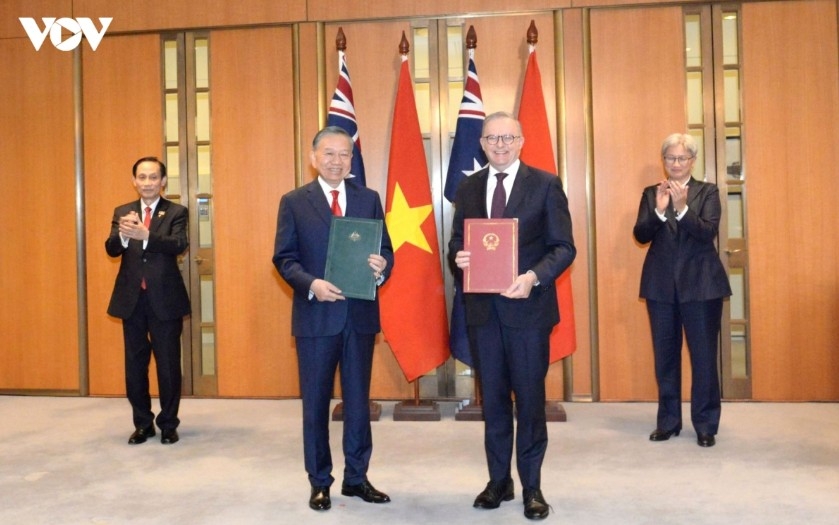
Party General Secretary and State President To Lam and Australian Prime Minister Anthony Albanese
Promoting open innovation, knowledge sharing, and workforce development
For Vietnam, developing science, technology, innovation, and high-quality human resources is no longer merely an option, but an essential requirement to achieve its ambition of becoming a developed, high-income nation by 2045. The Vietnamese Party and State have established a new development model in which knowledge, science, technology, innovation, digital transformation, and international integration serve as the primary drivers of economic growth.
Recent decisions approved by the Central Committee of the Communist Party of Vietnam reaffirm a determination to innovate development mindsets, improve institutions, build an independent and self-reliant economy tied to deep international integration, promote the private sector, and effectively attract international resources, particularly high-quality investment, advanced technology, modern management expertise, and skilled human resources.
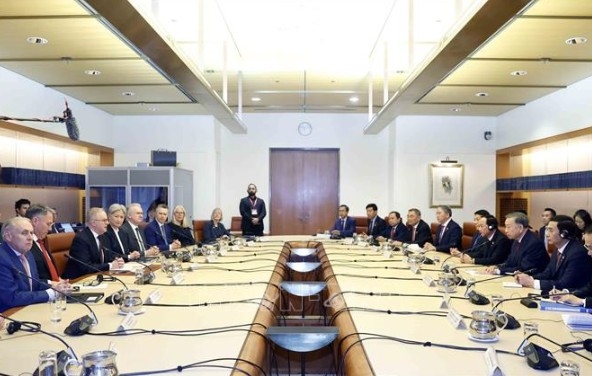
During talks between Party General Secretary and State President To Lam and Australian Prime Minister Anthony Albanese, both leaders concurred to position science, technology, innovation, and digital transformation as new drivers of bilateral relations. They agreed to expand cooperation in strategic fields such as artificial intelligence (AI), semiconductors, quantum technology, biotechnology, biomedicine, marine research, critical minerals, and green hydrogen.
They consented to accelerate joint research projects and link universities, research institutes, and enterprises toward forming a Vietnam-Australia technology connectivity space and developing a high-quality workforce.
At the talks between Party General Secretary and State President To Lam and Australian Prime Minister Anthony Albanese
A key highlight was the Forum on Science, Technology, Innovation, Education, Training, and Human Resource Development, which marked a qualitative breakthrough.
Science, technology, innovation, and strategic tech sectors have officially joined trade, investment, and education as new growth pillars, thus enhancing the resilience of both economies.
Speaking at the forum, the top Vietnamese leader noted that the Indo-Pacific remains the world's most dynamic growth center while serving as a region where both cooperation opportunities and rising non-traditional security challenges converge.
This reality requires nations like Australia and Vietnam to strengthen cooperation, build more resilient supply chains, promote open innovation, share knowledge, and jointly train a workforce for the future.
Vietnam and Australia have built a solid foundation of cooperation in recent years, marking an important transition from traditional trade and exchanges toward a partnership grounded in knowledge, high technology, and sustainable development. The two nations established the Australia for Innovation program with a 10-year commitment (2018-2028), serving as an effective bridge between management agencies, research institutes, and businesses. Furthermore, the Australia-Vietnam Strategic Technology Center is expanding its research scope from 5G and 6G into AI, semiconductors, cybersecurity, and quantum computing.
Most recently, in 2026, Vietnam’s Ministry of Science and Technology approved a joint research program focusing on strategic technologies for the 2026-2028 period. During the visit, the two sides signed cooperation agreements on the digital economy and sustainable aquaculture development in Vietnam, concrete steps toward implementing Resolution No. 36 on the Strategy for Sustainable Development of Vietnam's Marine Economy. With this foundation established, the next task is to connect programs, research facilities, capital, and markets into a broader cooperative ecosystem.
Vietnam is shifting rapidly from attracting investment to co-development, from receiving technology to co-creating technology, and from participating in value chains to securing higher value-added positions in global value chains. Meanwhile, Australia is accelerating its Southeast Asia Economic Strategy to 2040 to build sustainable and resilient supply chains with the region. These aligned efforts create crucial opportunities for future collaboration.
Proposing key priorities, Minister of Science and Technology Vu Hai Quan suggested focusing resources on strategic technologies including AI, semiconductors, cybersecurity, quantum technology, biotechnology, clean energy, and marine technology. He recommended developing the Strategic Technology Center into a shared platform while connecting venture capital and tech funds so outstanding lab inventions can reach the market directly.
He also urged selecting specific industries and enterprises, particularly small and medium-sized enterprises (SMEs), to implement digital transformation and AI deployment, alongside developing joint research teams, shared laboratories, and programs connecting scientists with businesses.
Attracting overseas Vietnamese talent for national development
Relations between Vietnam and Australia have advanced across all fields, including politics, economics, trade, investment, education, science and technology, defense, and people-to-people ties.
The Vietnamese community in Australia is the fourth largest worldwide, making notable contributions to bilateral cooperation. Entrepreneurs, intellectuals, experts, and students in Australia have demonstrated strong unity, actively supporting diplomatic missions and undertaking practical activities oriented toward their homeland.
At a meeting with the Vietnamese community in Australia, representatives of the overseas Vietnamese community expressed pride in their heritage and delight at Vietnam's development achievements. They voiced confidence that under the Party's leadership, headed by Party General Secretary and State President To Lam, Vietnam-Australia relations will reach new heights that are substantive, effective, and sustainable.
Tran Ba Phuc, President of the Vietnamese Business Association in Australia, affirmed that the association works closely with the Vietnamese Embassy to build a strong community. The organization serves as a bridge between businesses, promoting investment, trade, technology transfer, innovation, and human resource development, while deepening friendship between the two peoples.
Calling for greater involvement of overseas Vietnamese scientists in emerging fields, particularly AI, Professor Chu Hoang Long, Director of the Centre for Vietnam Policy Research at the Australian National University, emphasized that alongside researching, mastering, and applying AI, Vietnam should coordinate with the international community to build governance mechanisms that guide AI development for the common good while mitigating potential risks at national and global levels. He affirmed his readiness to collaborate with Vietnamese colleagues in this key area.
Australia is home to numerous Vietnamese-origin scientists, experts, and entrepreneurs working at prestigious universities, research institutes, and companies. This talent pool represents a direct resource for Vietnam’s priority development sectors if connected systematically and effectively.
During a meeting with the Vietnam-Australia Scholars & Experts Association (VASEA) To Lam, development of new productive forces. He called on them to connect Vietnamese research institutions with Australian partners in areas of strength, such as education, AI, semiconductors, high-tech agriculture, renewable energy, and strategic minerals. He emphasized that beyond technology transfer, the focus should be on spreading scientific mindsets and innovative methodologies to help train high-quality domestic talent.
The Vietnamese intellectual community in Australia expressed a desire for long-term mechanisms to mobilize overseas Vietnamese resources effectively. They proposed mechanisms to attract scientists, experts, and individuals capable of acting as chief architects for major national challenges, while continuing to refine the innovation ecosystem by strengthening ties between the state, research institutions, and enterprises, and expanding networks connecting Vietnamese intellectuals in Australia with domestic organizations and businesses.
On this occasion, the two sides adopted three joint statements: a Joint Statement on Deepening the Vietnam-Australia Comprehensive Strategic Partnership, a Joint Statement on Enhancing Economic Resilience, Adaptation, and Recovery, and a Joint Statement on Strengthening Cooperation in Science, Technology, and Innovation, alongside signing multiple cooperation documents.
The state visit to Australia by General Secretary and State President To Lam has solidified political trust while laying the foundation for a modern cooperation model rooted in knowledge and high technology.
With strong political determination, alongside proactive initiatives from businesses, research institutes, and overseas intellectuals, Vietnam-Australia relations are poised for new breakthroughs that support each nation's development goals.
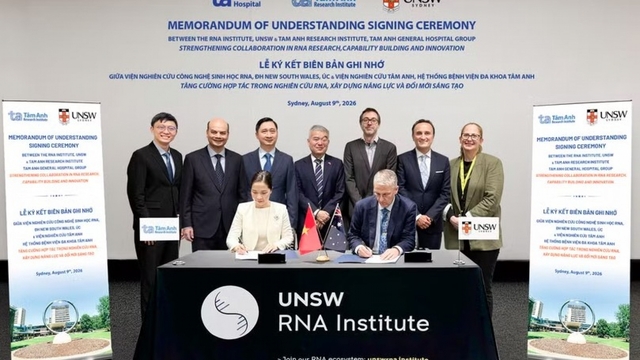
Recently, Tam Anh Research Institute and the UNSW RNA Institute at the University of New South Wales (UNSW), Australia, signed a Memorandum of Understanding (MoU) to develop RNA technology, opening up prospects for next-generation medicines and vaccines for influenza, lung cancer, and colorectal cancer.
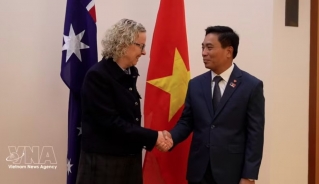
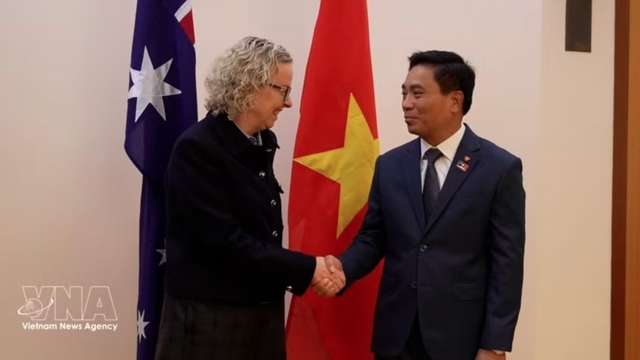
Vice President of the National Assembly Nguyen Doan Anh and Deputy Speaker of the Australian House of Representatives Sharon Claydon discussed measures to strengthen cooperation between the two legislatures during their meeting in Canberra on August 12.
Recently, Tam Anh Research Institute and the UNSW RNA Institute at the University of New South Wales (UNSW), Australia, signed a Memorandum of Understanding (MoU) to develop RNA technology, opening up prospects for next-generation medicines and vaccines for influenza, lung cancer, and colorectal cancer.
Vice President of the National Assembly Nguyen Doan Anh and Deputy Speaker of the Australian House of Representatives Sharon Claydon discussed measures to strengthen cooperation between the two legislatures during their meeting in Canberra on August 12.







.JPG&w=640&q=100)





Bình luận
Bình luận của bạn sẽ được xét duyệt trước khi đăng