
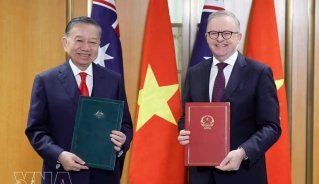
Vietnam-Australia Joint Statement on Deepening Comprehensive Strategic Partnership
Vietnam and Australia have issued a Joint Statement on Deepening the Comprehensive Strategic Partnership between the two countries.

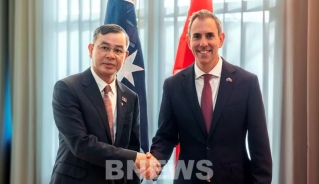
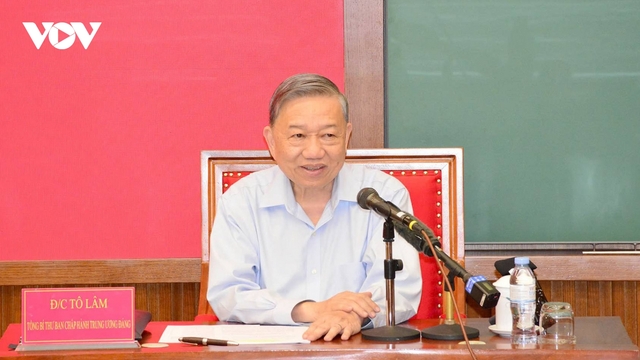
VOV.VN - Vietnamese Minister of Foreign Affairs Le Hoai Trung and his Australian counterpart Penny Wong co-chaired the 8th Vietnam - Australia Foreign Ministers' Meeting (FMM-8) in Canberra on August 12 within the framework of Party General Secretary and State President To Lam's state visit to Australia.
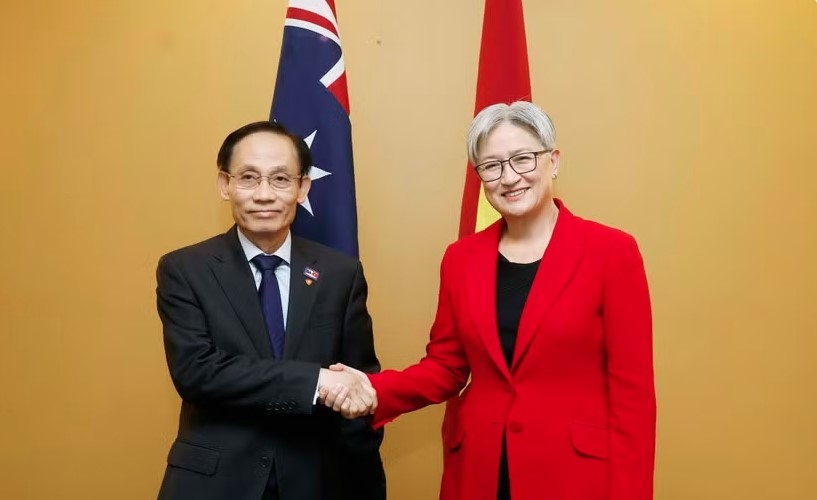
At the meeting, both ministers compared notes on bilateral ties as well as regional and international issues of mutual concern. They praised the convening of FMM-8 during the state visit, following up on high-level exchanges and major outcomes, including the adoption of three joint statements that demonstrate deep strategic trust, shared interests, and aligned visions between the two nations.
They welcomed the effective implementation of the Action Program for the Vietnam - Australia Comprehensive Strategic Partnership (2024-2027), which has yielded notable progress across all six pillars.
Defence and security cooperation continues to deepen, while two-way trade doubled over the past five years to exceed US$14 billion in 2025. Joint efforts in education, training, development, science, technology, innovation, and people-to-people ties also expanded.
Minister Le Hoai Trung called for turning high-level commitments into concrete outcomes, requesting that both foreign ministries serve as focal points to review progress, set priorities, and resolve obstacles.
Foreign Minister Penny Wong affirmed that Australia attaches great importance to its Comprehensive Strategic Partnership with Vietnam. She expressed Australia's desire to better utilize economic complementarities, deepen defence and security ties, and expand cooperation into new areas, particularly supply chain integration, high-quality investment, the green economy, the digital economy, clean energy, future industries, and innovation ecosystems.
On regional and international issues, both sides shared a vision of an open, inclusive, transparent, and rules-based regional structure where all nations contribute to maintaining peace, stability, and prosperity. They emphasized ASEAN centrality and agreed to strengthen coordination within ASEAN, the United Nations, APEC, and other multilateral forums.
Foreign Minister Wong reiterated Australia's commitment to Southeast Asia and supported Vietnam’s hosting of APEC 2027 to promote regional economic integration and sustainable growth.
Regarding the South China Sea (known in Vietnam as the East Sea), both sides highlighted the importance of maintaining peace, stability, security, safety, and freedom of navigation and aviation, resolving disputes through peaceful means in accordance with international law, including the 1982 United Nations Convention on the Law of the Sea (UNCLOS 1982).
On this occasion, Minister Le Hoai Trung held a working session with the Australian Department of Foreign Affairs and Trade (DFAT) to exchange experience on applying artificial intelligence (AI) in diplomacy.
Noting that Vietnam is entering a critical development phase aiming to become a developed nation by 2045, Trung emphasized that diplomacy for development serves as a top priority to mobilize resources for national growth. He asked Australia to share expertise in AI governance frameworks, AI integration in foreign policy planning, digital skills training for diplomats, and promoting safe and responsible AI use.
During the working session, DFAT announced three doctoral scholarships in AI for officials from Vietnam’s Ministry of Foreign Affairs. Both sides consented to enhance policy exchanges and explore making AI a regular topic of discussion within FMM and other inter-ministerial mechanisms.
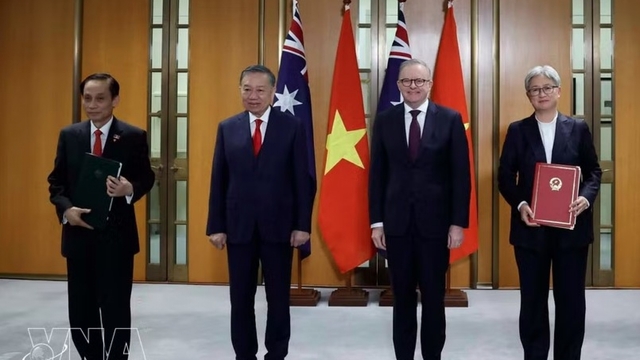
Vietnam and Australia have issued a Joint Statement on Economic Resilience Cooperation between the two nations.
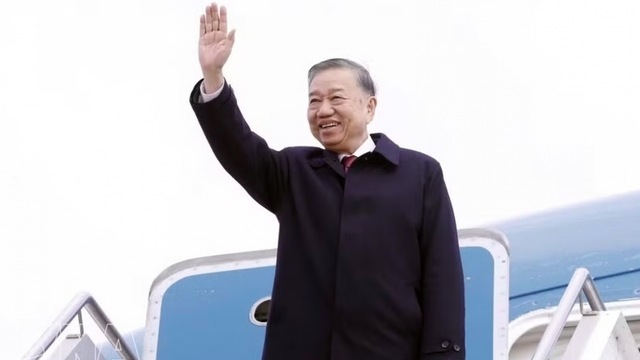
General Secretary of the Communist Party of Vietnam Central Committee and President To Lam and the high-ranking Vietnamese delegation left Canberra at noon on August 12 (local time), concluding their four-day state visit to Australia and departing for a state visit to New Zealand.




.JPG&w=640&q=100)





Bình luận
Bình luận của bạn sẽ được xét duyệt trước khi đăng