
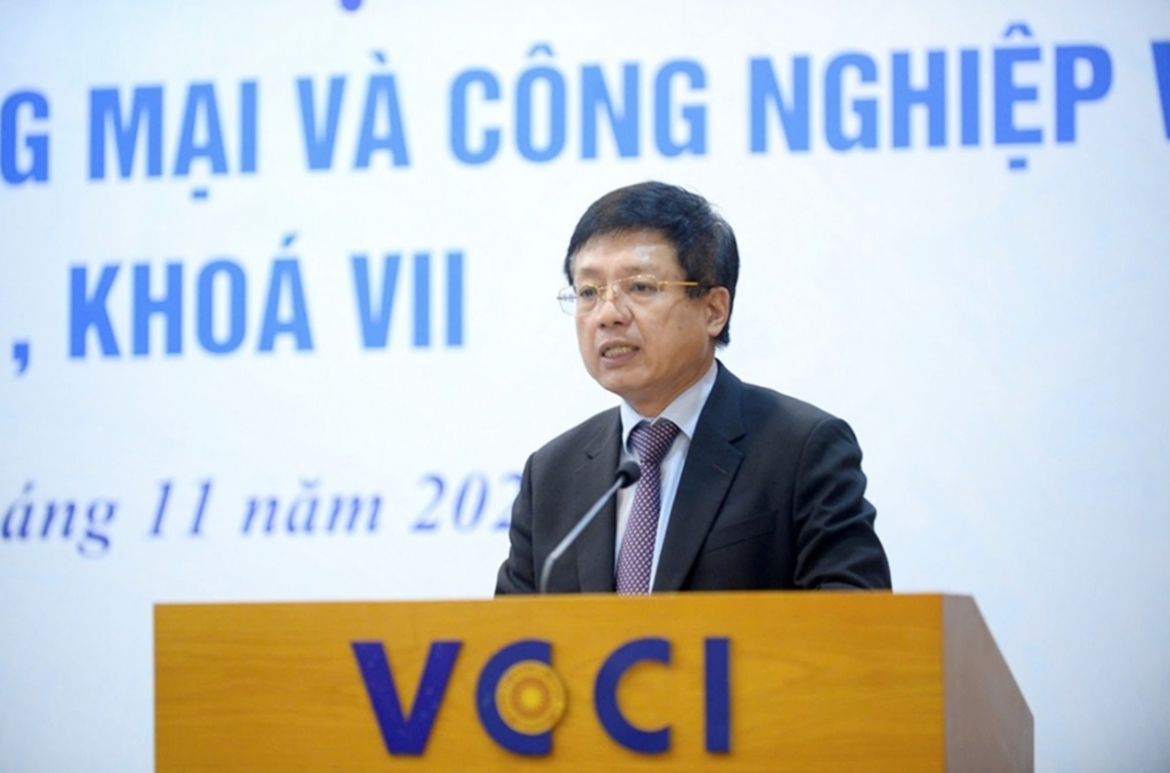

VOV.VN - Economic diplomacy is poised to become a driving force for Vietnamese enterprises amid a rapidly fluctuating global economy. Turning opportunities into growth requires an ecosystem with tight coordination among the State, overseas diplomatic missions, and the business community.
From promotion to shaping development space for businesses
The world is entering a period of profound transformation amid rapid and unpredictable changes. Strategic competition among major powers, economic fragmentation, trade protectionism, supply chain restructuring, alongside the boom of digital transformation, artificial intelligence, and green transition, are fundamentally reshaping production, business models, and the structure of the global economy.
In this context, foreign policy must go beyond fostering a peaceful environment or expanding international cooperation; it must directly contribute to generating new growth drivers for the economy. This is why economic diplomacy is increasingly identified as a core pillar of Vietnam's foreign affairs.
According to Assoc. Prof. Dr. Ho Sy Hung, President of the Vietnam Chamber of Commerce and Industry (VCCI), while economic diplomacy was previously tied primarily to trade promotion, investment attraction, or export support, its role has expanded significantly.
Hung noted that economic diplomacy must serve as an ecosystem connecting international resources, ranging from markets, capital, technology, knowledge, and high-quality human resources to innovation and global production networks, thereby enabling Vietnamese enterprises to integrate deeper into the global value chain.
This approach is essential as companies face competition that extends beyond pricing to include stringent requirements for green development, environmental standards, digital transformation, and modern governance.
As the national representative organization for the business community, VCCI has long prioritized foreign relations. Through nearly 500 business forums, trade and investment promotion programs, and international delegations annually, VCCI helps businesses expand markets, diversify partners, and access capital, technology, and advanced management methods. A network of more than 100 international partners, including chambers of commerce, business associations, and trade promotion organizations worldwide, acts as vital bridges linking Vietnamese enterprises with the global market.
Apart from connectivity, Vietnamese businesses are progressively participating in shaping international economic rules through mechanisms such as the APEC Business Advisory Council (ABAC), ASEAN-BAC, and the Greater Mekong Subregion (GMS) Economic Cooperation. According to the VCCI leader, this provides an opportunity for the voice of the Vietnamese business community to be reflected in the formulation of trade, investment, and sustainable development policies, rather than merely adapting to regulations after their enactment.
Drawing from these practical realities, Hung emphasized the guiding motto: "Diplomacy paves the way, businesses step forward, the economy takes off." He noted that this shows the synergistic relationship between state diplomacy and the business community in transforming foreign policy achievements into economic growth drivers.
Elevating economic diplomacy to pioneering force
Alongside expanding foreign relations, the VCCI President stressed the necessity of establishing effective coordination mechanisms among the Ministry of Foreign Affairs, Vietnam's overseas representative missions, VCCI, business associations, and enterprises. Synergy among these three pillars-diplomacy, business representative bodies, and corporations- is vital to turning international cooperation opportunities into concrete investment projects, trade contracts, and linkage chains.
Hung praised the role of Vietnam's overseas missions in supplying market intelligence, connecting partners, assisting businesses with policy navigation, and resolving hurdles during integration. However, in this new development phase, this role must be elevated.
Accordingly, diplomatic missions must act as outposts for economic diplomacy, proactively researching market trends, forecasting shifts, providing early risk warnings, and scouting cooperative opportunities before enterprises formally request them. This foundation shifts business support from reactive to proactive, and from short-term to long-term.
Conversely, the business community and industry associations must be more proactive in providing data regarding market demand, technological needs, capital requirements, and partner preferences so that diplomatic missions can deliver targeted support. According to the VCCI leader, a business forum is only successful if it yields tangible projects, enduring partnerships, and sustained long-term growth.
Reflecting on corporate realities, Hung asserted that economic diplomacy must continue innovating its mindset in the period ahead, shifting decisively from promotion to creation. This means tailoring strategies for each specific market, identifying priority sectors for key partners, and ensuring every foreign activity targets measurable, concrete outcomes.
Another emphasized requirement is establishing early warning mechanisms for international market shifts. Vietnamese enterprises face an expanding array of regulations regarding green standards, carbon emissions, traceability, data governance, and supply chain accountability. Timely updates allow businesses to adapt proactively, mitigate risks, and capitalize on integration opportunities.
Furthermore, the VCCI President proposed strengthening ties between Vietnamese enterprises and multinational corporations, investment funds, innovation hubs, universities, and international research organizations, particularly in strategic sectors such as artificial intelligence, semiconductors, digital technology, clean energy, and the green economy.
Simultaneously, the resources of overseas Vietnamese entrepreneurs and intellectuals should be effectively leveraged as critical conduits integrating domestic firms into global production and innovation networks.
According to Hung, VCCI will continue partnering with the Ministry of Foreign Affairs, ministries, localities, and overseas missions to amplify the voice of Vietnamese enterprises at international forums while channeling global resources toward national development. Active preparations for APEC 2027 are identified as a prime opportunity to promote the profile of Vietnamese businesses and promote trade, investment, and innovation.
Amid continued global volatility and intense competition, economic diplomacy serves not merely as a supportive tool for businesses, but as a primary driver of national competitive advantage.
By synchronizing Party diplomacy, State diplomacy, people-to-people diplomacy, and business action into a unified whole, diplomatic achievements can be effectively translated into economic growth, expanded development space, and elevated international standing for Vietnamese enterprises.
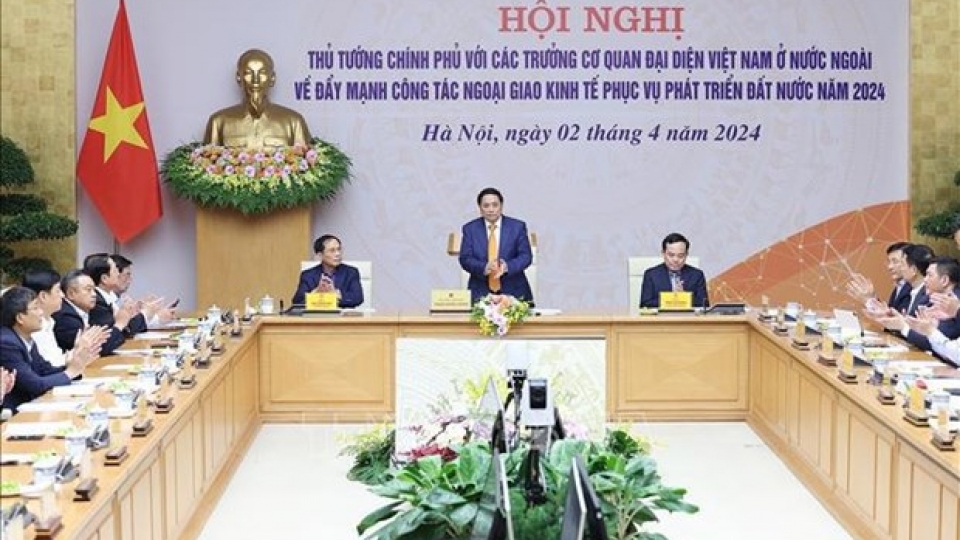
Prime Minister Pham Minh Chinh on April 2 chaired a hybrid conference with Vietnamese representative agencies abroad and provinces and cities nationwide to discuss enhancing economic diplomacy and its role in Vietnam’s development in 2024 and beyond.
Vibrant economic diplomatic activities in 2024 have contributed to creating a firm foundation for Vietnam and Singapore to upgrade their relations to a comprehensive strategic partnership level, according to Cao Xuan Thang, Trade Counsellor and head of the Vietnam Trade Office in Singapore.
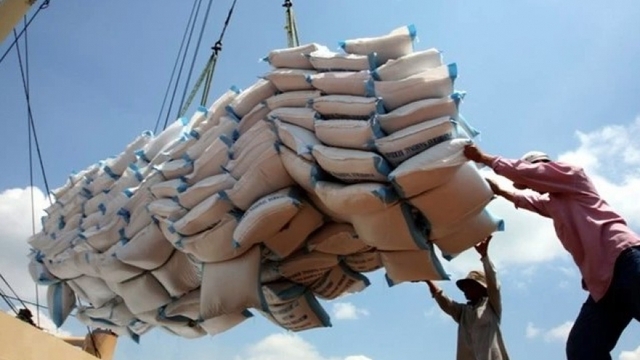
Vibrant economic diplomatic activities in 2024 have contributed to creating a firm foundation for Vietnam and Singapore to upgrade their relations to a comprehensive strategic partnership level, according to Cao Xuan Thang, Trade Counsellor and head of the Vietnam Trade Office in Singapore.
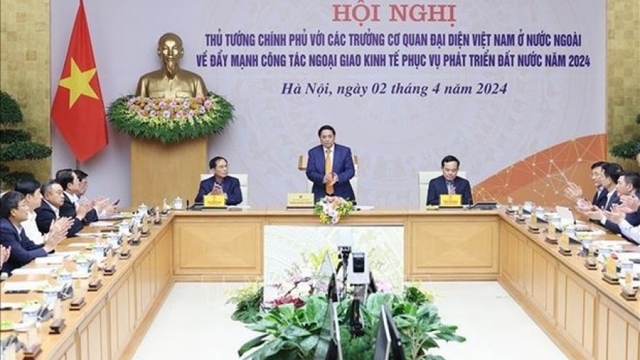
Prime Minister Pham Minh Chinh on April 2 chaired a hybrid conference with Vietnamese representative agencies abroad and provinces and cities nationwide to discuss enhancing economic diplomacy and its role in Vietnam’s development in 2024 and beyond.



.JPG&w=640&q=100)




Bình luận
Bình luận của bạn sẽ được xét duyệt trước khi đăng