Four strategic orientations for Vietnam's new phase of development
VOV.VN - In the new era of national development, enhancing national governance capacity serves as a vital prerequisite for Vietnam to fully tap resources, promote innovation, strengthen self-reliance, and realize its development goals through 2045.
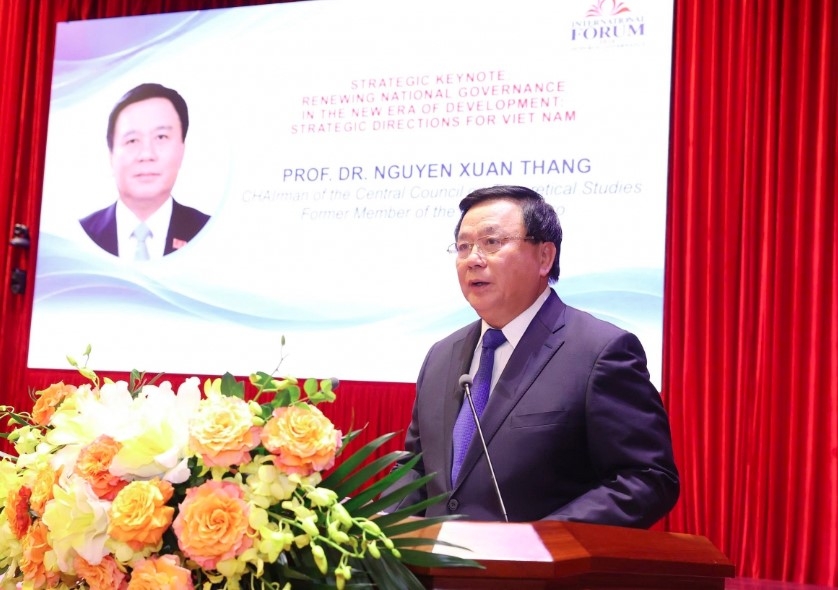
Prof. Dr. Nguyen Xuan Thang asserts that in the new phase, institutions must take the lead to create favorable conditions for new growth drivers.
Institutional refinement and resource mobilization for development
Speaking at the 2026 Annual International Forum on National Governance currently underway in Hanoi, Prof. Dr. Nguyen Xuan Thang, Chairman of the Central Council for Theoretical Studies, noted that Vietnam is moving toward a growth model increasingly reliant on productivity, knowledge, technology, innovation, and human capital quality, while simultaneously enhancing the country's autonomy, adaptability, and standing in the global economy.
Looking toward 2045, Vietnam must proactively build the foundations of a developed nation: scientific, technological, and innovative capacities, high-quality human resources, modern institutions, internationally competitive enterprises, digital and data infrastructure, the capacity to secure strategic resources, and adaptability to external volatility. This places national governance capacity in an exceptionally critical position.
Building on these requirements, Prof. Dr. Nguyen Xuan Thang emphasized four strategic orientations for Vietnam.
First, enhancing the State's capacity in organization and development facilitation
As growth relies increasingly on productivity, science, technology, innovation, and human capital quality, the State must possess the capacity to identify strategic priorities, concentrate resources on long-term foundations, and create an environment where enterprises, research and educational institutions, and society can unleash their creativity.
"A nation's resources only truly become a driving force for development when organized and combined effectively. Investment capital must be tied to technology and human resources; research needs to connect with enterprises capable of absorbing and commercializing it; digital infrastructure and data must serve production, management, and innovation; and international integration should empower Vietnamese businesses to enhance their capabilities and engage in higher-value segments of the value chain," Prof. Dr. Nguyen Xuan Thang analyzed.
Second, building high-quality institutions to make institutional strength a development advantage for Vietnam
Prof. Dr. Nguyen Xuan Thang noted that nearly 40 years of Doi Moi (renewal) have shown that institutions can open up vast spaces for development when removing constraints, expanding proactive autonomy, and unlocking social resources. In the new phase, institutions must also stay one step ahead to facilitate the formation and growth of new development drivers.
Artificial intelligence, data, green technology, the digital economy, and new business models are developing faster than traditional policy cycles. Institutions must therefore ensure stability, transparency, and predictability, while maintaining sufficient flexibility to pilot, evaluate, and adjust to emerging issues.
Prof. Dr. Nguyen Xuan Thang remarked: "The quality of institutions must ultimately be verified through implementation. Guidelines need to translate into policies; policies require adequate resources and clear implementation responsibilities; and emerging bottlenecks must be identified and addressed promptly. Bridging the gap between policy decisions and outcomes is set to become a vital requirement for institutional reform in the new phase."
Third, enhancing national strategic capacity, learning capability, and autonomy
According to Prof. Dr. Nguyen Xuan Thang, the 2045 target must serve as a reference point for present choices. The crucial question is not only what level of development Vietnam aims to achieve, but also what technologies the country needs to master by that time, what workforce qualification levels are required, what capabilities enterprises must possess, and what infrastructure and governance systems are necessary. From there, foundational preparations can be identified and implemented right in the current phase.
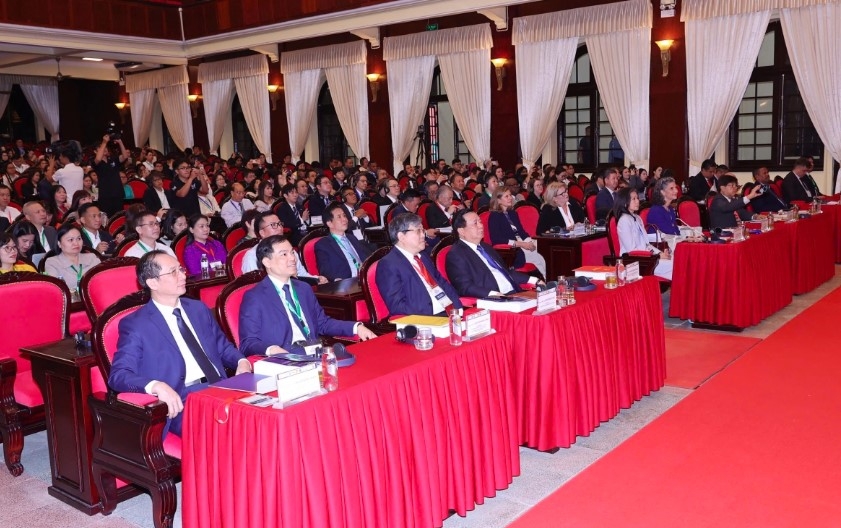
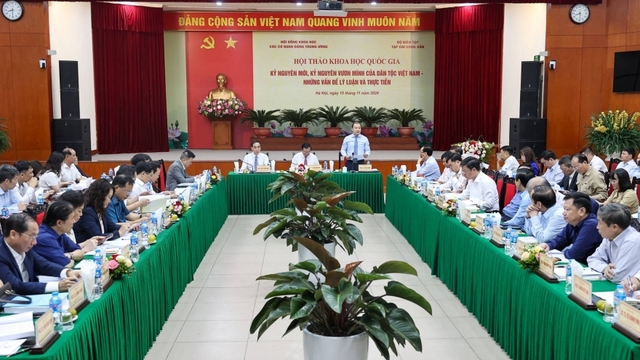
Delegates at the forum
Fourth, developing human resources and social capacity as the long-term foundation of national capacity
An economy relying more heavily on knowledge, technology, and innovation demands a corresponding advancement in human resources. Education, human capital development, alongside the attraction and utilization of talent, must be closely tied to the capabilities Vietnam requires for its new growth model.
For the public sector, requirements extend beyond professional expertise. Cadres, civil servants, and public employees need to enhance their capacities in policy analysis and advice, data and technology utilization, cross-sectoral coordination, execution organization, and tackling increasingly complex issues.
National capacity is built through the relationship among the State, enterprises, research and educational institutions, communities, and citizens. A capable State must be able to ignite, connect, and empower the capacities distributed throughout society to jointly participate in the development process.
This also poses a requirement for inclusiveness. Development policies must help citizens enhance their adaptive capacities, access new opportunities, and increasingly engage in high-value-creating activities.
"A visionary governance system must effectively address today's demands while equipping the country with sufficient capabilities to march toward the future. That is the requirement placed upon Vietnam's national governance reform on the journey toward 2045," Prof. Dr. Nguyen Xuan Thang concluded.
Transforming forecasting capacity into action capacity
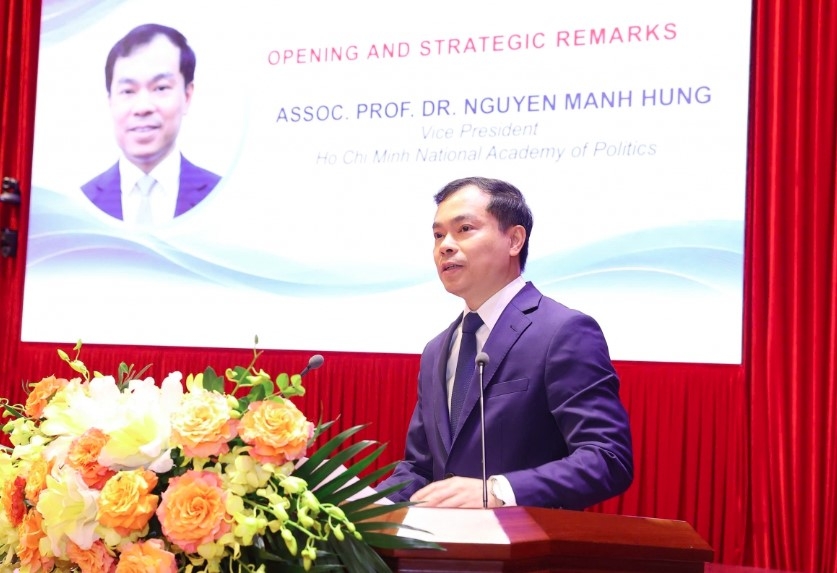
Assoc. Prof. Dr. Nguyen Manh Hung, Vice President of the Ho Chi Minh National Academy of Politics
In his speech at the forum, Assoc. Prof. Dr. Nguyen Manh Hung, Vice President of the Ho Chi Minh National Academy of Politics, noted that a future-ready government is not one that foresees everything, but one that possesses long-term vision, makes early preparations, adapts swiftly, and constantly self-renews. It is also a government that does not merely respond to what lies ahead, but actively shapes new development capabilities, working alongside citizens to shape a better future.
To achieve this, it is necessary to develop anticipatory governance thinking, proactively identifying changes to make preparations early and from afar. It is essential to listen to "weak signals", faint signs that may herald major shifts; regularly review familiar assumptions; build multiple scenarios; and test the resilience of policies under different circumstances.
"We must remain steadfast in our long-term goals, but stay flexible in our action plans; we must not place the country's future on a single scenario, no matter how plausible it may seem,"
That proactive spirit is also shown in preparing for unexpected disruptions that exceed ordinary forecasts yet carry profound impacts. While it is impossible to foresee every disruption, we can minimize vulnerabilities, reserve resources, and maintain the smooth operation of essential services when disruptions occur," Assoc. Prof. Dr. Nguyen Manh Hung emphasized.
According to him, a foreseen change cannot be allowed to become a surprise simply due to delayed preparation and action. The crucial task is to transform forecasting capacity into action capacity. Each scenario must be tied to specific response methods, clearly defining responsibilities,
To achieve this, it is imperative to connect the analytical capacity of public agencies with the knowledge and experience of scientists, enterprises, and the community. At the same time, scenarios must be periodically rehearsed, readiness levels assessed, and policies updated. Forecasting must become an essential part of the decision-making and governance process, rather than being limited to reports.
VOV.VN - A national symposium was held in Hanoi on June 17 to review nearly one year of operation of Vietnam's two-tier local government model and discuss measures to further refine the system.
VOV.VN - A ballot may be small, yet it carries great responsibility. It reflects trust in the future, expectations for modern, clean and action-oriented governance, and the aspiration to build a nation that develops rapidly, sustainably and strongly.
VOV.VN - A national symposium was held in Hanoi on June 17 to review nearly one year of operation of Vietnam's two-tier local government model and discuss measures to further refine the system.
VOV.VN - Vietnam, in its role as chair of the 35th Meeting of States Parties to the United Nations Convention on the Law of the Sea (UNCLOS), has called for stronger international cooperation, reaffirming the central role of UNCLOS and urging greater collective efforts in global ocean governance at the United Nations.









.JPG&w=640&q=100)







Bình luận
Bình luận của bạn sẽ được xét duyệt trước khi đăng