

VOV.VN - After 40 years of renewal, the Party’s policy thinking on international integration has continuously developed, moving from expanding external relations to establishing a strategy of comprehensive, deep, flexible and effective integration.
This process reflects the Party’s political resolve, strategic vision and capacity to adapt to global fluctuations.
Comprehensive, deep, flexible and effective integration
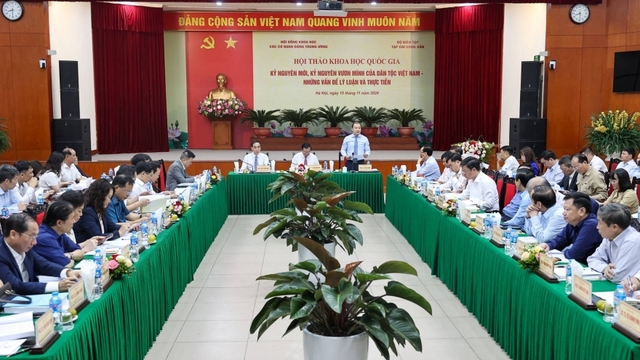
In a report submitted to the seminar “Independence and self-reliance in conjunction with international integration over 40 years of renewal: Solutions for implementing Politburo Resolution No. 59 of the 13th tenure,” Dr. Nguyen Thu Phuong of the Communist Review said that one of the decisive factors behind a historically significant shift was the strong renewal of the Party’s policy thinking on international integration.
From early orientations such as “expanding external relations” and “opening up” in the late 1980s, to the policy of “building an open economy integrated with the region and the world” established at the eighth National Party Congress in 1996, and then a major shift toward the view of “proactively integrating into the international economy” at the ninth congress in 2001, the Party’s policy thinking has continued to expand and be refined. Notably, from the eleventh congress in 2011, the Party clearly affirmed the requirement of “proactive and active comprehensive international integration,” and at the thirteenth congress in 2021, it emphasized deep, flexible and effective international integration. This evolution was further elevated in Politburo Resolution No. 59 dated January 24, 2025, on international integration in the new situation.
According to Dr. Nguyen Thu Phuong, Resolution No. 59 captures the flow of the era’s driving forces and elevates international integration with perspectives that carry revolutionary, breakthrough, national, scientific and contemporary significance.
“From 1986 to the present, the Party’s policy thinking on international integration has developed in a comprehensive manner, from initial awareness of the trend of globalization to the establishment of a strategy of comprehensive, deep, flexible and effective international integration. This process demonstrates the maturation of theoretical thinking, flexible adaptability to changes in the global situation, and at the same time affirms the Party’s consistent strategic vision. International integration under the Party’s leadership has become one of the important drivers of socio-economic development, the strengthening of national defence and security, the expansion of external relations, the enhancement of national standing, and the safeguarding of national interests,” she said.
Deputy Minister of Foreign Affairs Nguyen Minh Vu, in his report, noted that the concept of integration was officially mentioned for the first time in the documents of the Eighth National Party Congress in 1996, mainly emphasizing the task of economic integration.
During the 2001-2010 period, from the ninth to the tenth congress, the focus of international integration continued to be identified as the economic sphere. On that basis, the Politburo of the Ninth tenure issued Resolution No. 07 dated November 27, 2001, on international economic integration.
At the tenth Congress in 2006, the Party set out the policy of “proactive and active international economic integration, while expanding international cooperation in other fields.” The Eleventh Congress in 2011, the twelfth congress in 2016 and the thirteenth congress in 2021 further reflected policy thinking on external affairs and comprehensive integration in line with the new situation and the country’s development needs and realities. Based on the major orientations adopted at these congresses, the Party issued a series of important guiding documents on international integration, including Politburo Resolution No. 22 dated April 10, 2013, on international integration.
After 10 years of implementation and in response to new requirements, the Politburo issued Resolution No. 59 dated January 24, 2025, on international integration in the new situation. “This sound theoretical and conceptual foundation of the Party is an important basis for external affairs and international integration to be carried out effectively and to achieve notable outcomes, serving the country’s development, enabling Vietnam’s economy to grow in scale and integrate deeply with the world. By combining national strength with the strength of the times, and pursuing a renewal line alongside proactive and active international integration, Vietnam, from a starting point as a poor and backward country, has become one of the world’s 32 largest economies, with economic scale increasing nearly 100 times compared with 1986, and one of the world’s 20 largest trading nations,” Nguyen Minh Vu said.
Maximizing internal strength and effectively drawing on external resources
In his report, Associate Prof. Dr Dang Dinh Quy of the Diplomatic Academy of Vietnam said that from 2026 the country will enter a new era, with international integration facing new opportunities and challenges that differ markedly from the past 15 years. It is therefore necessary to define international integration as the cause of the entire people and the whole political system, under the unified leadership and direction of the Party and the centralized management of the State. International integration must place localities, enterprises and the public at the center, as the main actors and core driving forces. Accordingly, all policies on international integration must serve the interests of localities, people and businesses.
“Integration must be based on internal strength, enhancing and maximizing that strength while effectively drawing on external resources, closely linked with and making positive contributions to institutional improvement, human resource quality upgrading, the building of synchronized and modern infrastructure, and the enhancement of overall national strength and competitiveness; and closely connected with, and strengthening, linkages among regions, economic sectors and social strata,” Dang Dinh Quy said.
Sharing the same view, Associate Professor, Dr. Vu Van Phuc, former Editor-in-Chief of the Communist Review, said that on the principles of international integration, the Party clearly identifies two principles: serving national interests, and adhering to the basic principles of the United Nations Charter and international law. On overarching approaches and orientations, these include diversification and multilateralization; giving priority to relations with neighboring countries and major powers, and paying due attention to ties with traditional friends.
The orientation of international integration has been increasingly clarified: proactively and actively pursuing comprehensive international integration, shifting from the position of a late-comer to that of a country moving up and taking the lead in new areas. In international integration, the Party attaches importance to the relationship between firmly safeguarding independence and self-reliance and pursuing comprehensive, deep integration; the necessity of strengthening internal capacity; and a deeper grasp of the fundamental principles and norms of international practice.
“International integration has contributed to maintaining and consolidating a peaceful and stable environment, firmly safeguarding independence, sovereignty and territorial integrity, and protecting the socialist regime; breaking isolation, encirclement and embargoes; and bringing relations with countries and partners into greater depth, stability and sustainability, particularly by continuing to establish, expand and consolidate networks of comprehensive strategic partnerships, strategic partnerships and comprehensive partnerships with partners of strategic importance to the country’s sustainable development,” Vu Van Phuc added.
As the country enters a new period of development with intertwined opportunities and challenges, continuing to thoroughly internalize and creatively apply the Party’s policy thinking on integration is an important foundation for promoting overall national strength, safeguarding national interests, and realizing the aspiration for a prosperous and strong nation.
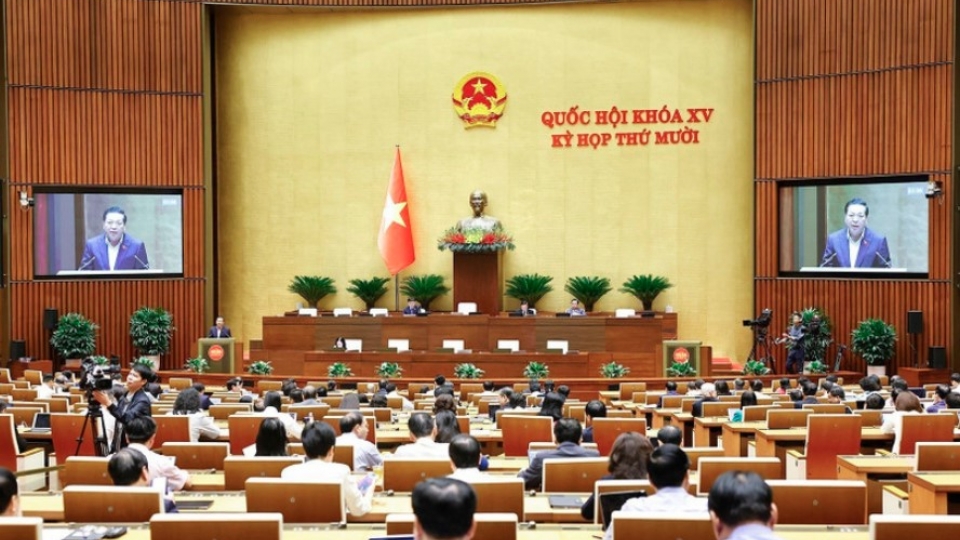
Lawmakers are expected to listen to a proposal and verification report on the National Assembly’s draft resolution on some specific mechanisms and policies aimed at enhancing the effectiveness of international integration efforts on November 19 morning at the 15th NA’s ongoing 10th session.

VOV.VN - Vietnam has taken a significant step in redefining its approach to international integration with the issuance of Resolution No. 59-NQ/TW by the Politburo, a move that elevates foreign affairs and global integration to a core, permanent national task amid a rapidly changing global landscape.



.JPG&w=640&q=100)




Bình luận
Bình luận của bạn sẽ được xét duyệt trước khi đăng