
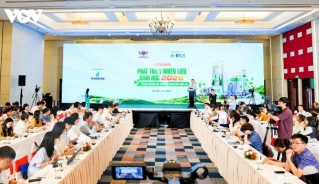
Biofuels contribute to national energy security
VOV.VN - Experts say biofuels can help reduce greenhouse gas emissions, support sustainable development, enhance energy self-sufficiency and contribute to national energy security.

Nearly eight years after the adoption of the Party Central Committee's Resolution No. 36-NQ/TW on Vietnam's Strategy for Sustainable Marine Economic Development to 2030 with a vision to 2045, the oil and gas industry has reinforced its position as a key driver of the marine economy.
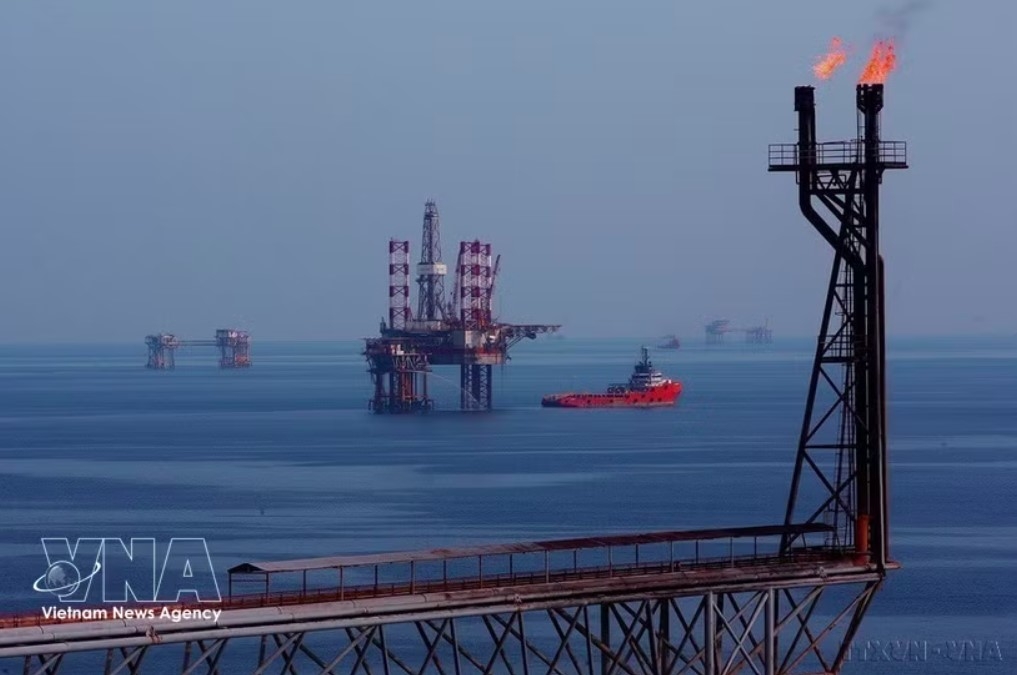
However, further legal and institutional reforms are also needed to unlock new growth opportunities and support the sector's transition toward cleaner energy and higher-value marine industries.
Strong performance despite challenges
According to General Director of the Vietnam National Industry-Energy Group (Petrovietnam) Le Manh Cuong, the group produced more than 155.2 million tonnes of oil and gas during the 2018-2025 period.
Petrovietnam also supplied 37.2 billion cubic metres of dry gas for power generation, helping produce more than 53 billion kWh of electricity annually, equivalent to around one-third of Vietnam's total electricity output. The group currently meets about 60% of domestic petroleum demand and 70% of the country's fertiliser needs.
Over the eight-year period, Petrovietnam generated total revenue of VND6.3 quadrillion (US$240.4 billion), recorded consolidated pre-tax profits exceeding VND414.5 trillion and contributed VND1.08 quadrillion to the State budget.
The group invested VND256 trillion during the period, while making significant progress in handling delayed and inefficient projects. Four of the five Petrovietnam projects previously included in the Ministry of Industry and Trade's list of 12 loss-making projects have now been removed from the list.
Major national energy projects, including the Block B gas-to-power chain, Blue Whale (Ca Voi Xanh) gas project, Son My liquefied natural gas (LNG) terminal and Long Phu 1 thermal power plant, are also moving forward.
The group is accelerating offshore wind power projects with potential capacity of several dozen gigawatts, expanding LNG-to-power projects and studying carbon capture and storage technologies to reduce emissions. Meanwhile, offshore oil and gas operations continue to support both energy production and the safeguarding of Vietnam's maritime sovereignty.
The group's strong momentum has continued into 2026. During the first six months of the year, all key production targets exceeded plan by between 5% and 23.1%.
Notably, crude oil output rose 14.2% year on year, marking the first increase since 2015 despite the natural decline of many mature oil fields.
Petrovietnam reported total revenue of VND734.7 trillion in the first half, up 49% from a year earlier. Consolidated revenue reached VND445.4 trillion, exceeding the target by 22% and rising 39% year on year, while State budget contributions climbed 27% to VND88.9 trillion.
Cuong said the group will continue investing in new growth areas, with priorities including oil and gas exploration and production, renewable energy, power generation, LNG and refining and petrochemicals.
Expanding the energy value chain
Despite its strong performance, the industry faces mounting challenges as oil and gas reserves decline naturally by 10-15% each year and production costs continue to increase. At the same time, developing new energy industries requires substantial investment and more flexible policy frameworks.
Industry representatives have called for the Government to revise regulations governing natural gas-fired power plants, LNG pricing and fuel allocation, while accelerating the development of legal frameworks for offshore wind power, hydrogen, carbon capture, utilisation and storage (CCUS), and nuclear energy.
They also proposed incentive mechanisms for deep-water exploration, marginal fields and offshore renewable energy projects, as well as special financial policies for Petrovietnam and adjustments to tax policies to improve business efficiency.
Ta Dinh Thi, Vice Chairman of the National Assembly's Committee for Science, Technology and Environment, said institutional reform would be crucial to creating new development space for Vietnam's energy sector.
He suggested introducing more flexible mechanisms, including regulatory sandbox models, to allow businesses to pilot new technologies and investment models under controlled conditions while enabling regulators to refine policies before large-scale implementation.
According to Thi, the 16th National Assembly will review several key laws affecting the energy sector, including the revised Petroleum Law, the Electricity Law and the Law on Environmental Protection, providing an important opportunity to establish a more transparent and enabling legal framework.
He also stressed that the industry should broaden its focus beyond the traditional oil and gas value chain to embrace offshore wind, gas-fired power, hydrogen, green ammonia and other clean energy industries.
In the new energy economy, value will increasingly come not only from underground resources but also from technology, data, infrastructure, operational capabilities and supply chain connectivity, he said.

VOV.VN - Ca Mau, Vietnam’s southernmost province, is boosting cooperation with Dutch partners in green development and the marine economy, with a focus on sustainable shrimp farming, climate adaptation, logistics and renewable energy.





.JPG&w=640&q=100)








Bình luận
Bình luận của bạn sẽ được xét duyệt trước khi đăng