Party and State leader: Foreign affairs must uphold pioneering role
VOV.VN - Foreign affairs has become an integral component of national comprehensive capacity, requiring the diplomatic sector to uphold its pioneering role and fulfill its vital, regular mission as the country enters a new era of development, General Secretary and State President To Lam has emphasized.
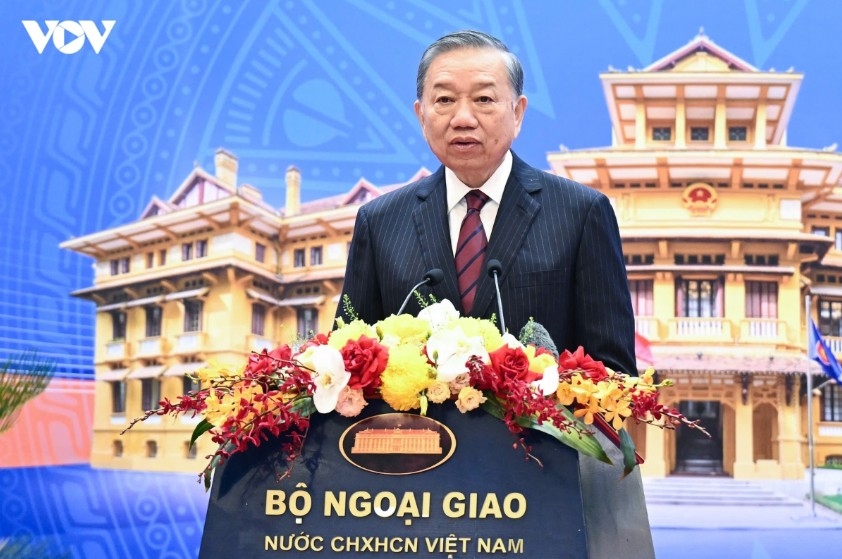
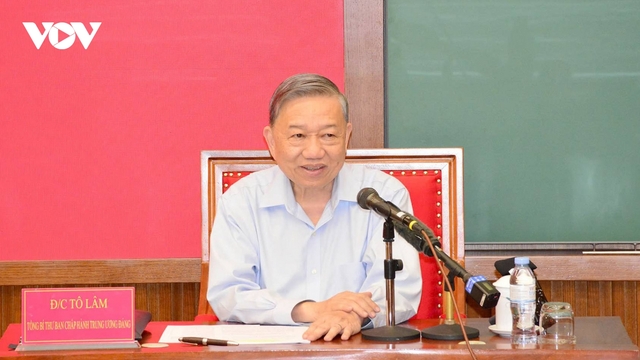
Party General Secretary and State President To Lam delivers a keynote address at the conference.
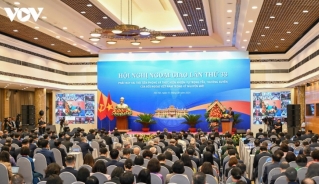
Addressing the opening of the 33rd Diplomatic Conference in Hanoi on the morning of August 1, under the theme “Promoting the pioneering role and fulfilling the crucial and regular task of Vietnam's external affairs in the new era”,the top leader noted that the conference takes place as the country embarks on a new developmental stage following over 80 years of national founding and 40 years of Doi Moi (Renewal).
With the Party Congress resolution explicitly designating external relations as a vital and regular mission for the first time, foreign affairs is no longer viewed merely as external relations but as a mission belonging to the entire Party, populace, military, and political system. Consequently, this gathering holds special significance, serving as a crucial occasion to deliberate on external work across the entire political system.
To Lam stressed that the 14th National Party Congress has charted the course for national development in the new phase. Resolution No. 59 of the 13th Politburo on international integration and Resolution No. 06 on implementing the foreign policy of the 14th Congress have established major directives, alongside the newly established Central Steering Committee for Foreign Affairs and International Integration.
With the strategic path clearly defined and guiding mechanisms being consolidated, the urgent task now is to execute implementation accurately, swiftly, and with concrete results.
Reviewing the results since the 32nd Diplomatic Conference, the General Secretary and State President affirmed that amidst a rapidly evolving and complex global context, with developments sometimes defying conventional forecasting, external relations and international integration have nevertheless been proactively implemented.
Foreign affairs has coordinated closely with national defense and security, contributing to safeguarding a peaceful and stable environment, protecting independence, sovereignty, unity, territorial integrity, and national interests, and ensuring that the country does not fall into a state of passivity or unexpected disadvantage.
Vietnam's foreign affairs expand and reach new heights
Vietnam has established or upgraded its relations to a Comprehensive Strategic Partnership with 9 partners, a Strategic Partnership with 11 countries, and a Comprehensive Partnership with 5 countries, demonstrating the country's growing political trust and stature.
Multilateral diplomacy achieved further milestones with the successful organization of the ASEAN Future Forum, the P4G Summit, and the Opening Ceremony for Signature of the United Nations Convention against Cybercrime, alongside Vietnam's re-election to the United Nations Human Rights Council for the 2026-2028 term.
Economic diplomacy closely aligned with the country's development requirements. Vietnam has signed 17 free trade agreements; import-export turnover ranks among the top 20 global trading economies; and foreign direct investment in 2025 reached its highest level in five years. Science and technology diplomacy received heightened focus, with diplomatic missions connecting research centers, technology conglomerates, experts, and overseas Vietnamese intellectuals with domestic needs. Cultural diplomacy, external information work, overseas Vietnamese affairs, and citizen protection continued to make practical contributions.
On behalf of the Party and State leadership, Party General Secretary and State President To Lam warmly praised the monumental and practical contributions of the foreign service personnel, who have consistently demonstrated courage, responsibility, and unwavering loyalty to the Fatherland, placing the national-ethnic interest above and beyond all else. Concurrently, the top leader pointed out that current shortcomings do not stem from a lack of guidelines, but primarily from the stages of concretization and implementation.
Innovating mindset and enhancing the quality of strategic forecasting
The Party chief emphasized that the more complex the situation, the greater the need to stay calm and proactive; confident yet not complacent, bold yet not adventurous, and flexible while steadfastly upholding principles.
Furthermore, international cooperation must be expanded alongside the consolidation of strategic autonomy, internal strength, and resilience. To bring the foreign policy guidelines of the 14th National Congress and Party resolutions to life, the leader urged the entire diplomatic sector and foreign affairs agencies to continuously innovate their mindset and elevate the quality of research, forecasting, and strategic advisory work.
"Research must focus on issues directly and long-term impacting Vietnam's security and development: strategic adjustments by major powers; shifts in economic, technology, and power centers; and fluctuations in trade, finance, energy, and water resources. Artificial intelligence, semiconductors, the digital economy, green transition, cybersecurity, and data security must be researched early and in depth. Research efforts must pay special attention to identifying opportunities and proposing concrete actions.
Every report must clearly answer: what is happening; how it impacts Vietnam; what the handling options are; what needs to be done first; and who is executing it. Reports must be concise, feature novel information, provide clear assessments, and offer actionable recommendations.
Exchanges between research bodies and practical operational units, as well as between domestic agencies and overseas missions, must be enhanced, while leveraging networks of experts, businesses, and overseas Vietnamese. Innovating mindset requires courage in proposing initiatives. Advisory staff must dare to raise issues, defend correct recommendations, and take responsibility for their opinions," the General Secretary and State President stated.
The top leader also requested that the diplomatic sector deepen and heighten the effectiveness of foreign relations. Established and upgraded relationship frameworks must be concretized through action programs and projects with measurable outcomes; upgrading relations marks the opening of a new chapter. The effectiveness of relations is demonstrated through the consolidation of a peaceful environment, the expansion of markets, the realization of projects, the advancement of technology and human resources, and practical benefits for the people.
Diplomacy directly serving renewal of growth model
The Head of State noted that the targets set for 2030 and 2045 entail extremely high demands. Therefore, diplomacy must directly serve the renewal of the growth model, while enhancing productivity, competitiveness, and economic autonomy.
Economic diplomacy must simultaneously track projects through to fruition. Priorities include mobilizing resources for science, technology, innovation, digital transformation, the development of the private economy, and improving the quality of foreign investment. Selective attraction must target high-tech projects, semiconductors, artificial intelligence, digital infrastructure, clean energy, biotechnology, and modern agriculture, while tying investment to technology transfer, workforce training, and the participation of Vietnamese enterprises in global value chains.
"Each overseas mission needs to understand national priorities and local advantages, identify the right partners, and closely monitor implementation. Ministries, sectors, and localities are required to prepare projects, mechanisms, sites, human resources, and absorptive capacities. External opportunities only translate into resources when internal readiness is secured. This is a collaborative endeavor engaging overseas missions, domestic bodies, businesses, and every citizen. Science and technology diplomacy must be treated as a routine mission. We are tasked with building networks of technology partners, connecting research institutes, universities, enterprises, and experts; tracking emerging trends, standards, and policies; and channeling appropriate knowledge and technology back home."
"Diplomacy should look beyond capital to actively seek knowledge, talent, and best practices. In tandem, we must elevate the quality of overseas Vietnamese affairs, cultural diplomacy, external communication, consular services, and citizen protection. Favorable conditions are to be created for expatriates to stay connected and contribute to their homeland by drawing upon networks of intellectuals, entrepreneurs, and experts. Consular services ought to be convenient and transparent; citizen protection must remain swift, precise, and responsible. Above all, every diplomatic endeavor must serve the nation and its people," the leader emphasized.
The General Secretary and State President directed the elevation of multilateral diplomacy and the implementation of comprehensive, synchronized, and effective international integration. Preparations for hosting the APEC Year 2027 must commence early regarding content, initiatives, facilities, human resources, and advocacy for support.
Furthermore, the implementation of Resolution No. 59 must closely link international integration with institutional completion and the reinforcement of internal strength. Special importance should be attached to building a contingent of foreign affairs personnel with sufficient virtue, competence, and prestige to meet the requirements of the new era. Excellence must be ensured across selection, training, evaluation, assignment, and utilization, using moral character, capability, and job performance as benchmarks. A core team of experts specializing in key geographical areas and emerging fields should be formed promptly, alongside mechanisms to attract and utilize talent both within and outside the sector.
Expressing confidence, the top leader stated that building upon Vietnam's revolutionary diplomatic traditions, intellect, courage, and responsibility, the entire diplomatic sector and foreign affairs forces will unite, act proactively and creatively, and successfully fulfill their duties, contributing to safeguarding peace, defending the Fatherland, expanding developmental space, and elevating Vietnam's stature.
Acknowledging the guiding directives of General Secretary and State President To Lam, Minister of Foreign Affairs Le Hoai Trung requested that the Conference promptly concretize and effectively execute the tasks to meet the requirements of the new era of national development. In its role as the Standing Body of the Central Steering Committee for Foreign Affairs and International Integration, the Ministry of Foreign Affairs will continue to closely link foreign affairs and international integration with the nation's defence, security, and development objectives, spanning from the central down to local levels.
The 33rd Diplomatic Conference will continue its work through August 7, with 18 working sessions.
VOV.VN - The 33rd Diplomatic Conference opened in Hanoi on August 1, setting a strategic foreign policy agenda to guide the country into a new era following the 14th National Party Congress.
VOV.VN - The 33rd Diplomatic Conference opened in Hanoi on August 1, setting a strategic foreign policy agenda to guide the country into a new era following the 14th National Party Congress.






.JPG&w=640&q=100)




Bình luận
Bình luận của bạn sẽ được xét duyệt trước khi đăng