
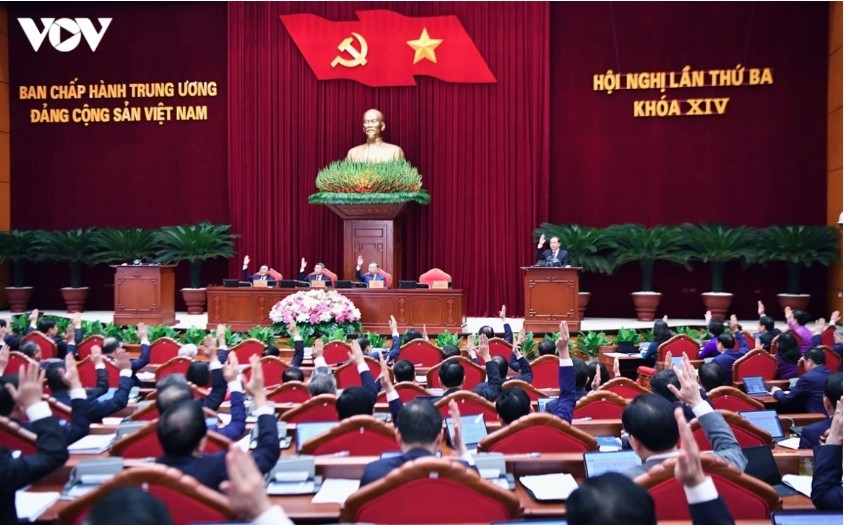

VOV.VN - Establishing a new growth model, restructuring the economy, and boosting industrialization and modernization on the foundation of science, technology, innovation, and digital transformation represent core, key tasks for the 14th National Party Congress tenure, aiming toward double-digit annual GDP growth during the 2026-2030 period.
The Resolution of the 14th National Party Congress emphasizes the imperative to successfully achieve the 2030 target of becoming a developing nation with modern industry and upper-middle income, while realizing the vision toward 2045 to become a developed, high-income nation.
The strategy targets an average annual GDP growth rate of 10% or higher from 2026 to 2030. By 2030, per capita GDP is projected to reach approximately US$ 8,500, with manufacturing and processing accounting for around 28% of GDP, and the digital economy contributing roughly 30% of GDP.
To attain these ambitious goals, policy guidelines prioritize a breakthrough in developing science, technology, innovation, and national digital transformation. Alongside cultivating new growth drivers, a crucial requirement involves revitalizing traditional growth drivers through technological advancement.
While past growth relied primarily on capital investment, resource extraction, and low-cost labor, the new strategy centers on applying science and technology, innovation, the digital economy, and high-quality human resources to elevate manufacturing and processing to approximately 28% of GDP by 2030.
Highlighting the role of technology application in foundational industries such as metallurgy, chemicals, energy, mechanical engineering, and materials, Pham Van Quan, Deputy Director General of the Industry Agency under the Ministry of Industry and Trade, notes that mineral resources offer the most direct contribution to growth based on existing comparative advantages.
However, past exploitation focused mainly on raw extraction and primary processing. To build higher added value, investment must concentrate on science and technology for deep mineral processing, as mineral processing contributes directly and rapidly to double-digit growth.
Mastering technology simultaneously boosts GDP and solves the challenge of input material and equipment autonomy, representing a concrete shift in the growth model.
Economists emphasize that technological transformation serves not merely as a growth driver, but as the bedrock of the new growth model, a strategic imperative to enhance growth quality, competitiveness, and sustainable development in the new era.
Dealing with the realities of an open economy with total trade turnover reaching nearly 200% of GDP, where goods are produced mainly for exports yet yield disproportionate profit margins, Dr. Le Duy Binh, Director of Economica Vietnam, points out structural limitations.
While the foreign direct investment (FDI) sector accounts for over 85% of total national export turnover, concentrated largely in processing, manufacturing, and high-tech goods, domestic supply chain integration remains limited.
Vietnam currently relies predominantly on technology imports, while local technological innovation remains modest. Party resolutions on science and technology reform address these economic bottlenecks directly, inspiring efforts among both the business community and regulatory agencies to ensure technology becomes the key to strengthening technology absorption, dissemination, and ultimately technological creation, spanning foundational technologies to modern fields such as semiconductors and information technology.
Echoing this view, experts underscore the strategic importance of recent Politburo resolutions. Resolution 57 establishes science, technology, innovation, and digital transformation as the foundation of new productive forces.
Meanwhile, Resolution 10 defines methods for mobilizing external resources, shifting from attracting FDI by quantity to selecting high-quality, high-tech FDI capable of leading value chains and generating spillover effects for domestic enterprises.
Assoc. Prof. Dr. Vu Thanh Huong, Head of the Faculty of International Economics and Business at the University of Economics and Business, Vietnam National University, Hanoi, stresses that technology serves as the foundation for innovation.
Integrating technology and innovation into products increases the added value of exports, thereby driving up profits and raising incomes for workers in export sectors.
Renewing the growth model represents a fundamental shift toward a new development paradigm in which science, technology, innovation, and digital transformation operate as direct productive forces and primary growth engines.
However, establishing a new growth model is impossible under outdated management mindsets, requiring the removal of institutional bottlenecks to unleash all production resources. Concurrently, human resources and enterprises must sit at the center of the new model, where the state economy retains its leading role, the private economy serves as a primary driver, and foreign investment connects directly with technology transfer and endogenous capacity building.
Reflecting on recent corporate initiatives, Dr. To Hoai Nam, Vice President and General Secretary of the Vietnam Association of Small and Medium Enterprises, observes that many businesses actively restructure operations across three key pillars: adopting new technologies; expanding into domestic and international markets while leveraging free trade agreements (FTAs) to integrate deeply into global supply chains; and accelerating green production, sustainability, and digitalization.
The Resolution of the 14th National Party Congress sets the target for Total Factor Productivity (TFP) to contribute over 55% to economic growth by 2030. This target demonstrates that achieving double-digit growth relies not on expanding capital investment or labor scale, but on enhancing productivity through technology and innovation.
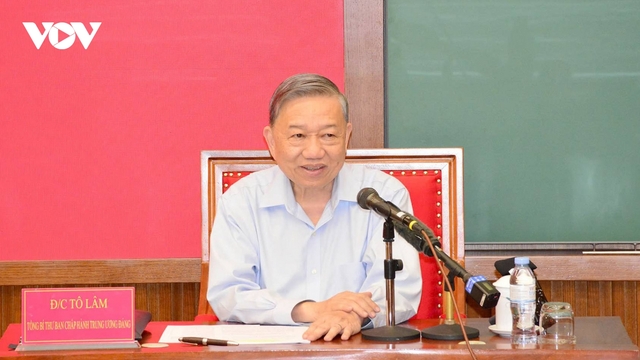
Establishing a development model in productivity, knowledge, technology, and human capital provides the path for Vietnam to grow faster, sustain development, strengthen autonomy, and elevate its competitive standing in the global economy, as emphasized by General Secretary and State President To Lam at the opening session of the 3rd plenum of the 14th Central Committee.
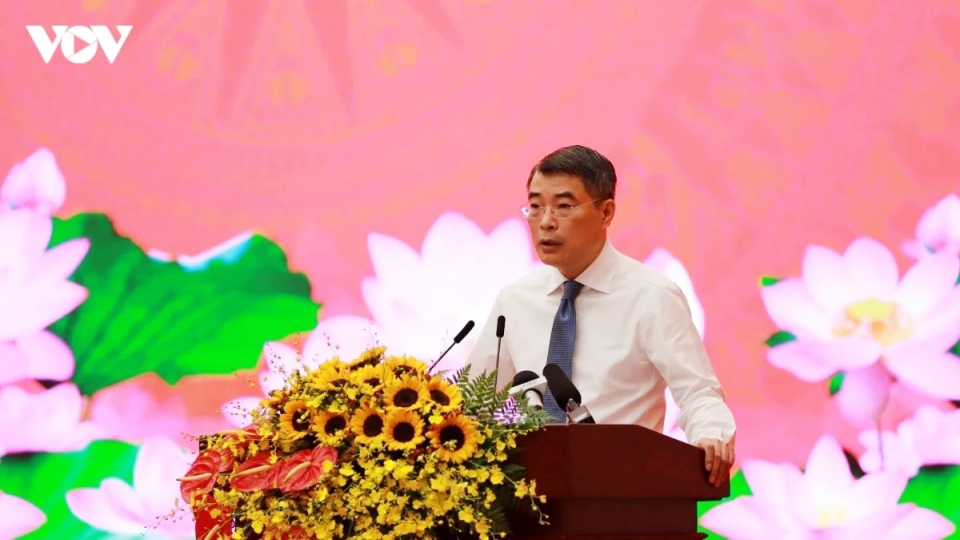
VOV.VN - Vietnam will need a fundamental shift in development thinking, institutional reform and innovation-driven growth to achieve its target of annual economic expansion of more than 10% during the 2026-2030 period, Prime Minister Le Minh Hung said on June 13.
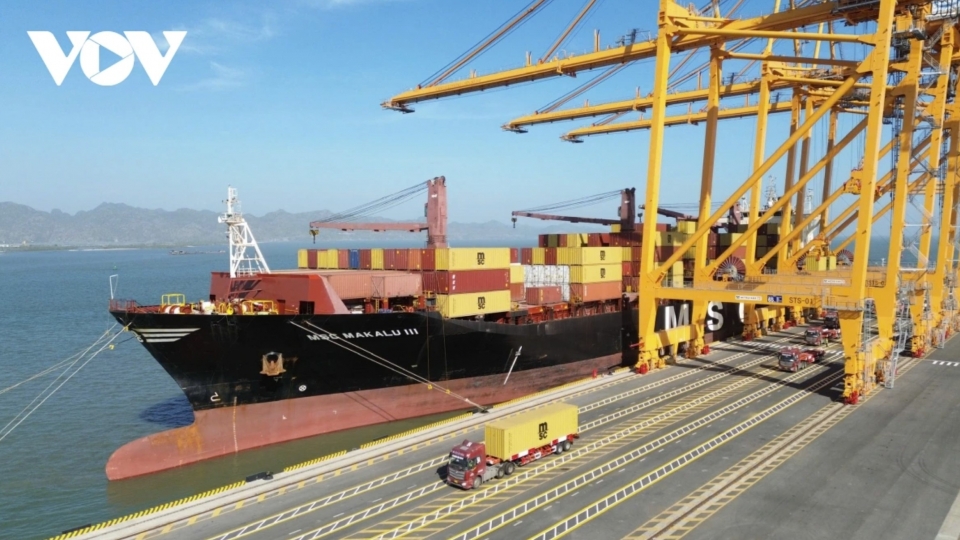
VOV.VN - With a target of double-digit GDP growth in 2026-2030 and the ambition of becoming a high-income country by 2045, many economists say Vietnam’s economy needs to move quickly to redefine its growth model, with stronger economic restructuring toward greater efficiency, sustainability and innovation.

VOV.VN - Vietnam will need a fundamental shift in development thinking, institutional reform and innovation-driven growth to achieve its target of annual economic expansion of more than 10% during the 2026-2030 period, Prime Minister Le Minh Hung said on June 13.




.JPG&w=640&q=100)








Bình luận
Bình luận của bạn sẽ được xét duyệt trước khi đăng